My search for the perfect operating system.
Lets get one thing clear: I am a massive simp for UNIX® and UNIX-like operating systems. Suffice it to say, the chance of me ever fully moving onto a system that is not a *NIX is near-impossible. I think they are incredibly comfortable and whilst not perfect, are perfect for me.
I switched to Linux full-time at 11-12 (5 days before 12th birthday) after having experimented with it for a few years before on an old Compaq laptop. I instantly fell in love with the system and its customisability as well as its fluidity in the CLI. Unlike Windows, what I'd used to that point, it was built to be scripted. This later led me down a massive Linux rabbithole which I eventually came out of later, settling in Fedora. However, my experimentation did not end there.
I tried every *NIX I could find, each of the major *BSDs, OpenIndiana, and a whole host of other systems. Each one had things I liked and disliked and each one I could see myself becoming comfortable on. However, each had its own drawbacks. For linux, the nature of it being a large open source project means that there are countless flavours (or "distros" as they call it) to choose from which inevitably leads to fragmentation. Even the attempts to unify packaging are fragmented with Flatpak, Snap, and AppImage only the top three.
Eventually however, I'd try OSX for the first time. I'd obviously known of it beforehand, growing up in California where Apple devices are all but first class, and being the birthplace of Apple itself. My school had used MacBooks in place of Chromebooks for some time, and I'd been given a loaner for schoolwork at home as my school is a mixed home-school program. Instantly, I began to notice how polished it was. I could still open the terminal, still compile things, still see all the *NIX heritage I'd loved yet it all came with this just mfffghhh that was unlike anything else I'd used to that point. I've used a few Macs since and each has had the exact same polish and ease as the last.
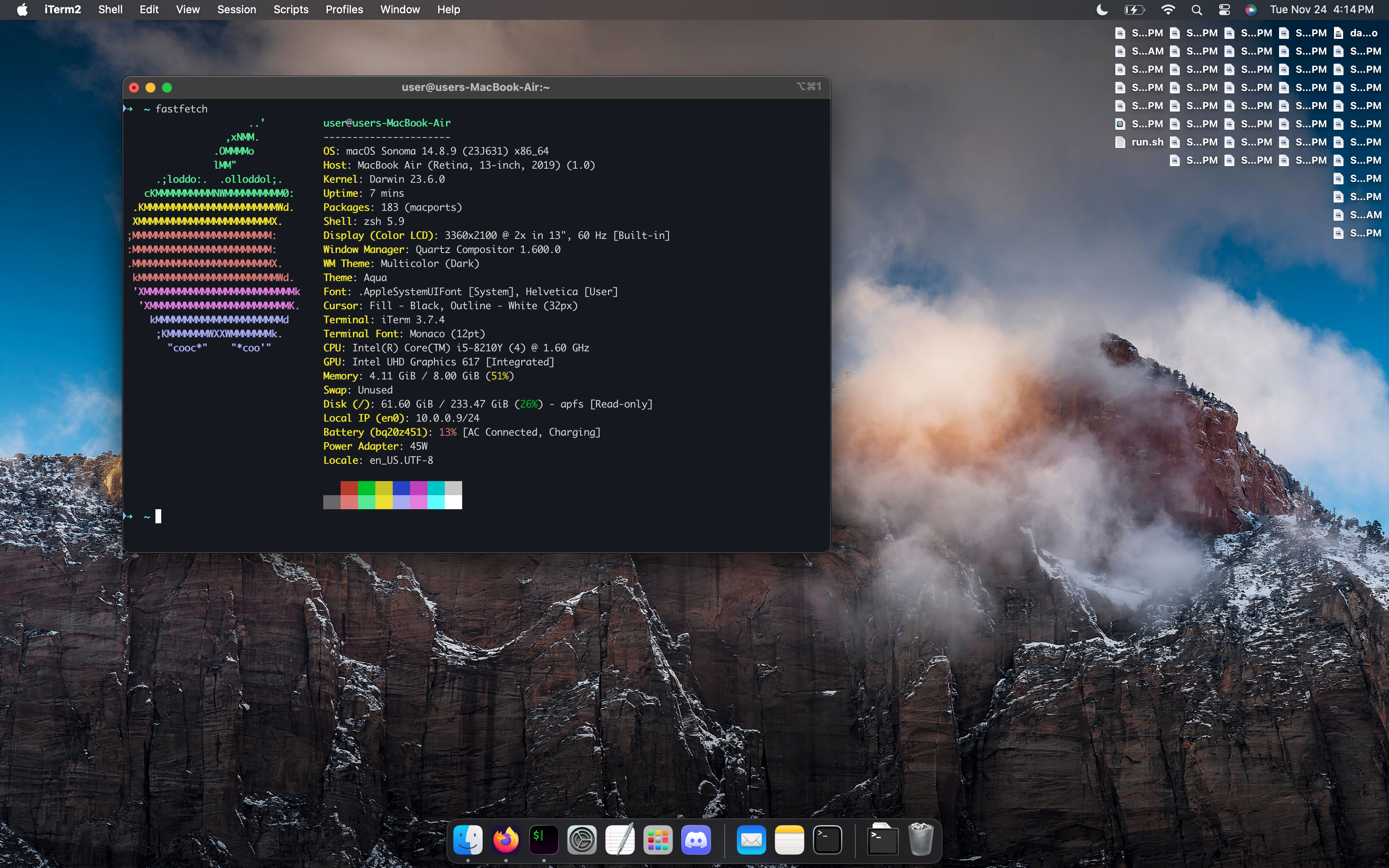
Screenshot of macOS X Sonoma running on my MacBook Air.
Ultimately, however, it too had some shortcomings. Superuser permissions being increasingly stripped down each major version, no way to disable the GUI, and no first-party & integrated package manager. It is also plagued, like every other major system, with not one graphics toolkit but many, fragmenting its design and leaving the end user with an inconsistent experience lest they limit themselves to seldom using Electron or GTK applications.
FreeBSD and OSX however both had something interesting that at the time I'd not known Linux had, the ability to inject functionality into the already built kernel. This enables thing like hot-reloading a GPU driver or adding support for a filesystem directly in kernelspace rather than going through Filesystem in Userspace as with Linux. This immediately interest me, and led me down a rabbithole that ultimately led to the discovery of Microkernels.
For those not aware, within operating systems development there are two types of kernels that are dominant: Monolithic kernels (like those that power Linux, FreeBSD, and NetBSD) and Microkernels (like those that power RedoxOS, GNU Hurd, and MINIX). The former is where most core operations, such as filesystem drivers, hardware drivers, the scheduler (regulates what processes access the CPU, what way they do so, and in which order), and other things. This has the benefit of less resource overhead but the downside that if one thing fails it can drag the whole system down with it.
Microkernels however, run these facilities (among others) on top of a more minimal kernel, meaning each runs as its own process within the system. This allows things such as swapping out essentially any facility of the kernel live without a reboot, and it also means that if one facility fails it can be restarted easily without affecting other components. This however, comes at the cost of performance as the communications between processes have a speed limit.
This issue has become less important over time with hardware becoming significantly better than it was even 20 years ago, and with more robust IPC systems coming about. It is now much more feasible to have a microkernel-based system which hobbyist projects like RedoxOS and Managarm exemplify. I personally think these are the best model, and are by far the most interesting.
I'm still looking for the perfect system for me. Overall, if you have any suggestions, let me know wherever you got this link from :3.